
May 2024
Cash Flow Management for Financial Stability: Profitability, Debt Service, and Projections
Cash flow is a critical component of a business’s financial health and performance, yet it is often confused with profitability. While profitability reflects whether a business earns more than it spends, cash flow determines whether the business can meet its ongoing financial obligations. Understanding the distinction between these two concepts is essential for sound financial planning, debt management, and long-term projections.
Cash Flow vs. Profitability
Cash flow refers to the movement of cash through a business. It captures how cash flows through the business from operating, investing, and financing activities. Unlike profitability, which is measured on an income statement, cash flow reflects only cash transactions – including income, expenses, capital purchases, capital sales, money borrowed, and loan payments. Cash flow analysis focuses on whether sufficient cash is available to meet obligations as they come due, regardless of when revenue is earned or expenses are recorded.
Profitability is a business’s ability to earn a profit, meaning revenues exceed expenses, and it is measured using the income statement. While this appears straightforward, not all cash outflows are business expenses. For example, loan payments consist of principal and interest, but only interest is recorded as an expense. Principal payments affect the balance sheet and cash flow, not the income statement. On term loans, depreciation replaces principal payments as the expense on the income statement. However, depreciation and principal payments rarely align, particularly when accelerated depreciation strategies such as Section 179 expensing or Bonus Depreciation are used.
How Can a Business Be Profitable and Not Cash Flow?
A business can be profitable but still experience cash flow challenges because, as defined above, profitability and cash flow measure different aspects of financial performance. Profitability is defined as a situation where revenues exceed expenses over a given period. However, not all cash transactions affect profitability, and not all expenses require immediate cash expenditure. Several factors can cause profitability and cash flow to diverge:
- Loan principal payments reduce cash but are not recorded as expenses.
- Borrowed funds increase cash flow but do not generate profit.
- Owner withdrawals reduce cash without affecting profitability.
- Timing differences, such as seasonal revenue or delayed collections, can create cash shortages even when overall profits are positive.
As a result, a business may appear financially successful on paper while struggling to meet short-term cash obligations. Or a business may cash flow because inventories were sold down, but the business may not be profitable.
Failing Cash Flow
The debt service coverage ratio (DSCR) measures a business’s ability to service its debt using available income. It is calculated by dividing income available for debt service by scheduled debt payments. While the exact formula may vary depending on the analysis tool or data source, the core concept remains the same: comparing available revenue to required debt payments.
A debt coverage ratio of less than 1:1 occurs when the income available for debt service is less than scheduled debt payments. This means that after adjusting items such as depreciation, income taxes and personal expenses, the business does not generate enough cash to cover debt payments. Debt coverage ratios in FINPACK Projections and Financial Analysis tools are accrual measures, meaning inventory changes are included. This prevents a business from projecting to sell down inventories or increase accounts payable to improve the DSCR. Only the debt coverage ratios in the Tax Forms are cash based.
How Can We Address a Negative DSCR?
The ability to address a negative debt service coverage ratio depends on whether the analysis is based on historical data or projections.
Historical data: When analyzing past performance, the die is cast, it is too late to “fix” a negative debt coverage ratio. This is a signal that adjustments may need to be considered to improve repayment capacity in the future.
Projections: When working with projections, improving the debt coverage often requires improving profitability. This may involve increasing income and reducing expenses. Improving cash flow by lowering family living costs or adding personal income will also help if feasible. Simply reducing debt payments does not address the underlying issue when cash generation is insufficient.
Sometimes debt coverage problems result from very aggressive debt repayment terms. In that case, refinancing or restructuring debt may solve the problem. But it is still important to dig deeper to evaluate whether low profits are contributing to the problem.
In periods of low industry profitability, a business may need to tread water for a period of time by using up working capital to meet financial obligations. This may involve selling down inventories or delaying expenses. This will not improve the DSCR but it will help the business cash flow and hopefully return to profitability.
Cash Flow Projections
FINPACK’s Cash Flow Projection tool projects both cash flow and profitability (net income). Accurate cash flow projections depend on properly aligning projected cash movements with balance sheet information and expected timing of transactions. Projecting profitability requires not only cash income and expense but also inventory changes. Changes in accounts receivable, accounts payable and prepaid expenses are reflected in the Ending Inventories page. These entries are not only important to projecting net income, they are also critical to projecting DSCR. If these entries are left blank, the projection may show large changes in these accounts which will result in erroneous debt coverage calculations.
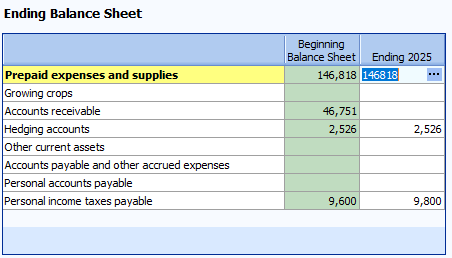
Accounts Receivable (AR): When preparing a cash flow projection, it is important to consider the information documented on the prior period’s ending balance sheet. Outstanding accounts receivable at year-end represent cash that is expected to be received in the upcoming period and should therefore be included as income in the cash flow projection. To avoid double-counting, consideration should be given to whether these receivables are already reflected in other projected revenue entries. While this is often not the case, it is important to check. Under the cash flow section in FINPACK labeled ‘Ending Balance Sheet,’ the beginning balance for accounts receivable should be reviewed to determine whether it was included in cash income. Consider whether the beginning balance sheet included a one time payment that was received during the projection year, or whether the farm expects to be owed funds at year end. Either situation may require adjusting the ending balance sheet to reflect the correct amount of receivables.
Example 1: Beginning AR includes insurance proceeds that were not collected before the end of the year. The projection includes this as income during the year. The business owner does not expect an insurance indemnity at the end of the year. In that case projected ending AR should be reduced by the amount of cash inflow.
Example 2: Beginning AR includes uncollected custom hire income. The custom hire income is included in cash inflow. If the producer expects to earn custom hire income again in the coming year, and that income is not included in cash inflow, then that income should be included in ending accounts receivable.
Accounts Payable (AP): Accounts payable also play a significant role in cash flow projections. Outstanding payables at the end of the prior period represent expenses that will require cash payments during the projection period and should be reflected as expenses in the cash flow projection. Within the cash flow, the related operating expense category labeled “Accounts Payable” represents the amount expected to be paid during the planning period. When entering detailed data for projected accounts payable under the expense section (called the ‘related operating expense’ section in monthly cash flow with budgets), remember that the ‘Select from balance sheet detail’ option (a button that pulls values from the beginning balance sheet) is available. Care should be taken to avoid double-counting expenses already included elsewhere in the projection. Double counting can occur, for example, when an outstanding bill is recorded as “Repairs” and also in the ‘Accounts Payable” expense category. When entering data in the cash flow ‘ending balance sheet’ section, the accounts payable line should be reviewed to determine what the correct ending balance should be for the projection year. Think about what expenses were paid in the projection. If a normal year’s expense plus the beginning payables were included as cash expenses, the ending accounts payable balance should be reduced. If only a normal year’s cash expense was included, then Ending AP should generally equal beginning AP. If not all expenses were included in your plan by year-end, then the end balance should be increased. Adjusting this value ensures the cash flow projection accurately reflects the operation’s financial position at the end of the year.
Example 1: Beginning AP includes an unusual repair bill. The projection shows a full year of repair expenses plus paying off the carryover repair bill. Ending AP should be reduced by the amount of the repair bill.
Example 2: Beginning AP includes a feed bill that is generally carried for 30 days. The projection shows one year’s worth of feed expense. Ending AP should include the carryover feed bill.
Prepaid Expenses: When preparing cash flow projections, it is important to consider expected changes in prepaid expenses based on cash expense included in the projection. The key again is whether a normal full year of expense was included in the plan, or whether expenses were reduced to ‘use up’ beginning prepaids. For both annual and monthly projections, it is important to distinguish between what has already been paid in advance and what will require actual cash expenditure during the projection period. Under detail on the prepaid expense line for the ‘Ending Balance Sheet’ section there is a list of expenses and supplies that reflects the detail that was included on the year-end balance sheet (in some cases there is no detail), where individual adjustments can be made.
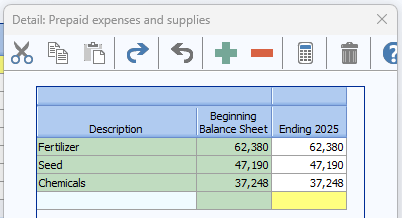
Example 1: The farm carries a large amount of prepaid fertilizer on the balance sheet. The projection shows a full year’s cash expense for fertilizer with the expectation that fertilizer will be prepaid again at the end of the year. Ending prepaids should equal beginning prepaids, absent other business changes.
Example 2: In the same situation, cash fertilizer expense is reduced because fertilizer was purchased before the beginning of the year. Ending prepaids should be reduced by the amount of the beginning prepaid expense.
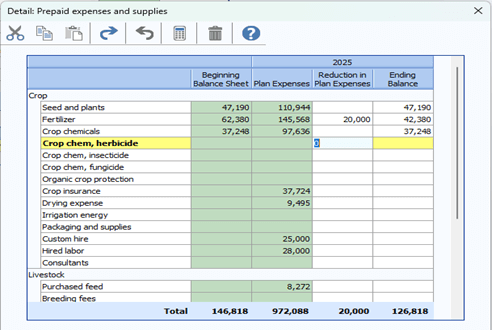
For a monthly cash flow projection with budgets, particular care is needed when projecting ending prepaid expenses. Budgets typically reflect a ‘typical’ annual input expense, but if the farm carried prepaids into the year, it may plan to ‘use up’ some of those inputs rather than prepay for fertilizer at the end of the year. In that case, the projected cash expense should be reduced accordingly. In the ‘Ending Balance Sheet’ data entry detail, the balance sheet value for each prepaid input can be compared with the cash expenses implied by the budget. The ‘Reduction in Planned Expenses’ column can then be used to adjust what cash will be spent during the projection plan. At the same time, the ending balance sheet value for the prepaid item should be adjusted to the level expected at year end. It is also important to note that if detail is entered for any one of these prepaid inputs, it must be entered consistently for all the inputs. In this example, cash fertilizer expense based on the budget expenses will be reduced by $20,000, resulting in a $20,000 reduction in ending prepaids.
Summary
Helping businesses and producers understand the difference between profitability and cash flow is key to effective financial management. Profitability does not automatically mean a business has positive cash flow, and positive cash flow does not necessarily indicate profitability. To be financially successful over time, profitability should provide enough funds for the investing and financing needs of the business.
Cash flow issues can lead to problems such as a negative debt service coverage ratio (DSCR), which occurs when a business lacks enough income to cover expenses and debt. Simply restructuring debt payments often will not resolve a negative DSCR. Instead, improving profitability or managing cash demands is necessary.
Accurate cash flow projections depend on careful alignment between the prior period’s ending balance sheet and projected cash activity. Special attention should be given to accounts receivable, accounts payable, and prepaid expenses to ensure cash inflows and outflows are realistic. By adjusting these items in concert with projected cash income and expenses, producers can develop more reliable cash flow projections and the financial metrics that come from them.